No Man Is an Island: Exploring Robinson Crusoe Across Disciplines
Author: Kari Nugent
Date: 03-25-2026
Article Thumbnail: 
A classic story sparked fresh conversation and cross-disciplinary insight as more than 30 students gathered for a lively panel discussion on Robinson Crusoe. The event brought together perspectives from economics, sociology, philosophy, and history with faculty panelists Scott Kistler, Kenneth West, Jessica Oladapo, and Wesley Davenport - demonstrating how a single text can open the door to rich, varied interpretations.
From an economic lens, the discussion explored themes of resourcefulness, self-sufficiency, and the foundations of trade. Davenport noted how Crusoe's island became a case study in scarcity, labor, and value creation, prompting attendees to consider how economic principles emerge even in isolation.
Sociological perspectives added another layer, examining questions of identity, power, and human connection. Oladapo gave examples of Crusoe's relationship with Friday and the broader implications of culture, hierarchy, and colonial influence.
Philosophical insights invited attendees to dig deeper into the human condition. What does it mean to be alone? How do individuals construct meaning in isolation? West's conversation touched on religion, morality, independence, and the search for purpose, connecting Crusoe's experience to timeless existential questions.
From a historical standpoint, the novel was situated within its broader context—an era shaped by exploration, imperialism, and shifting worldviews. Kistler's perspective helped frame the story not just as fiction, but as a reflection of the attitudes and assumptions of its time.
The panel was a lead-in to the evening's guest lecturer, Dr. Issac Stephens, associate professor of History at the University of Mississippi, and author of "Daniel Defoe and the Legacy of Life Writing".
Kistler helped summarize Stephens' remarks. "Stephens described the influence of "life writing" on Robinson Crusoe. This includes the long tradition of European biography, going back to Plutarch and St. Augustine, but also the hagiographies of saints and martyrs in the Christian tradition. Puritans in England also began writing about their own spiritual lives, and Daniel Defoe, as a Puritan-influenced English Presbyterian, was clearly influenced by this tradition when he wrote Robinson Crusoe and other novels after it."
"We really enjoyed having these conversations among instructors of different disciplines," said Kistler. "It's something we already do in our offices and around campus, but this time we got to open it up to the public. Having Dr. Stephens on campus was a pleasure, and we were glad to learn so much from him about the historical context of Robinson Crusoe. We hope to keep holding events like this in the future."
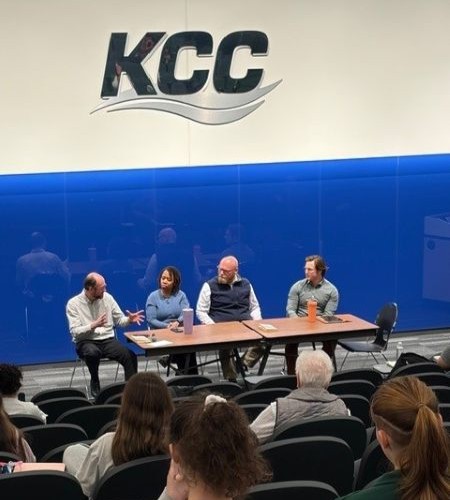
L-R: Scott Kistler, Jessica Oladapo, Kenneth West, and Wesley Davenport.